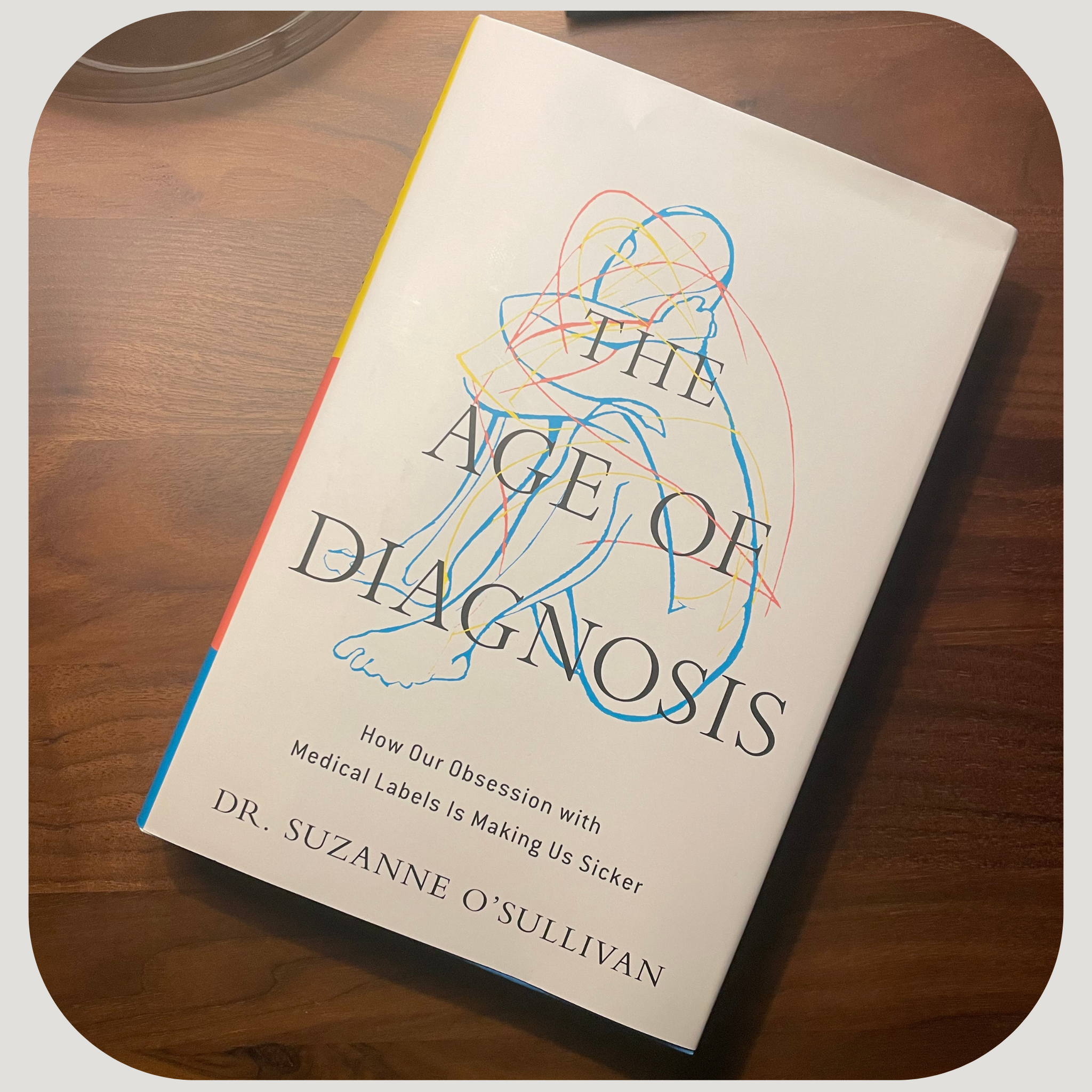
What Happens When a Diagnosis Becomes an Identity?
In The Age of Diagnosis, Suzanne O’Sullivan asks a question that many of us feel but rarely say out loud: What are we gaining (and what might we be losing) by diagnosing more and more of the human experience?
To be clear, this book is not anti-diagnosis. In fact, one of its strengths is how thoughtfully O’Sullivan interviews patients who experienced profound relief after finally being named, seen, and understood through a diagnosis. There is real comfort in having language for suffering. A diagnosis can validate pain, reduce shame, and help people access care that was previously out of reach.
And yet, as I read this book, I kept coming back to a tension I see often in therapy: the line between understanding yourself and constraining yourself. O’Sullivan asserts: “A diagnosis can be a doorway to care—but it can also quietly become the walls of the room.”
The author spends time exploring physical diagnoses like Lyme disease, long COVID, and even cancer, but as a therapist, I found myself especially drawn to her chapters on mental health; specifically depression, autism, and ADHD. In recent years, there has been a strong cultural push toward diagnosis (sometimes even self-diagnosis) especially for milder symptoms or completely understandable responses to stress, trauma, burnout, or a misaligned environment.
What concerns me—and what O’Sullivan articulates so well—is not that people are seeking answers. It’s that we may be answering too quickly and too narrowly. When every struggle becomes a disorder, growth can quietly stall. People may begin to relate to themselves as limited rather than responding.
From a therapeutic perspective, this reinforces something I return to again and again: people are not their diagnoses. Labels can be useful tools, but they are not identities, and they are not destinies. When we zoom out and view someone holistically—through their history, environment, relationships, nervous system, and meaning-making—we often see something far more complex and hopeful than a checklist of symptoms.
The Age of Diagnosis doesn’t ask us to throw diagnoses away. It asks us to hold them more lightly. To remember that before there was a label, there was a person, and that person is still there, capable of growth, change, and adaptation.